
What is pancreatic cancer?
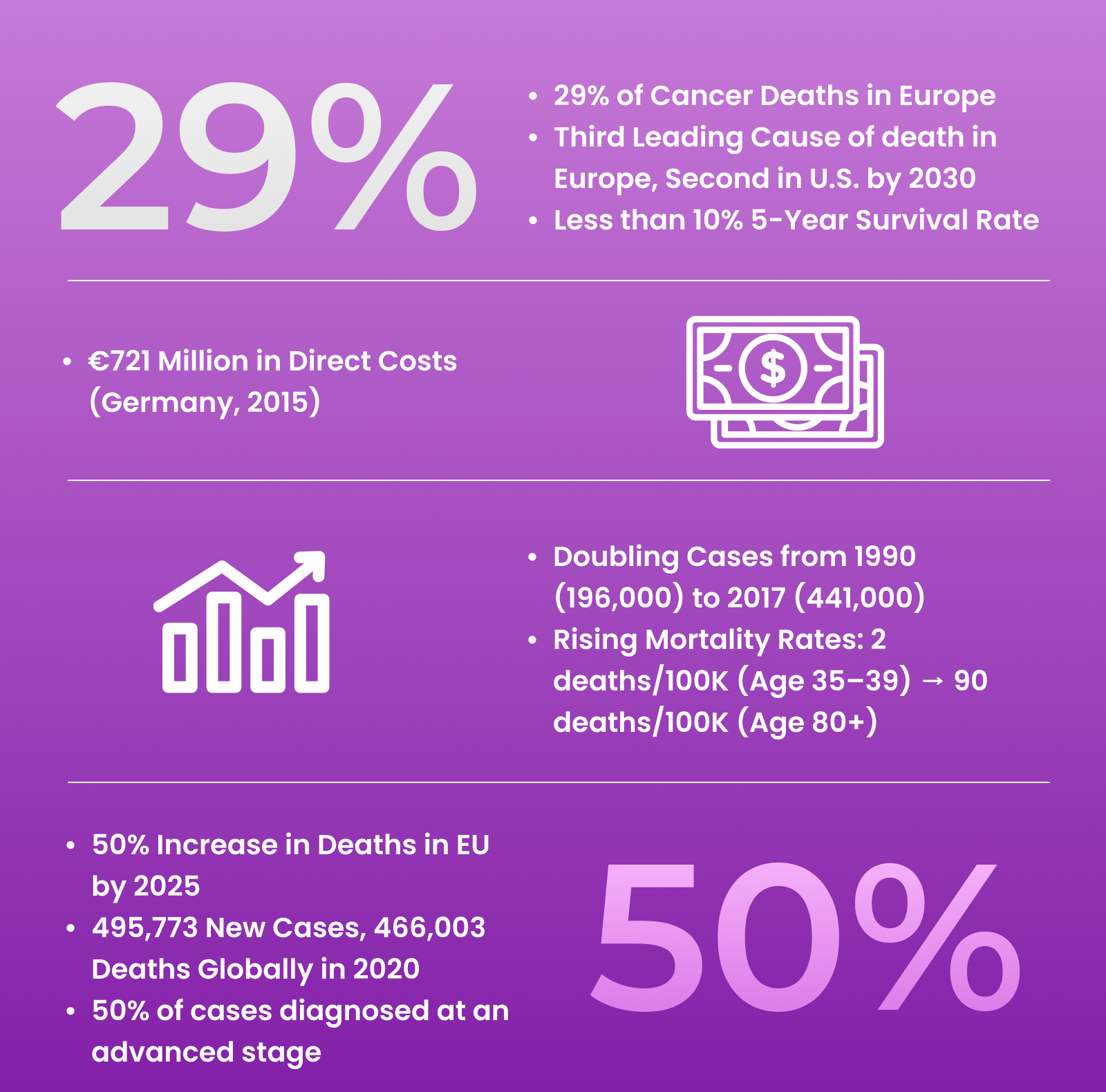
Pancreatic cancer is a formidable global health challenge, known for its aggressive nature and devastating impact. It stands as one of the leading causes of cancer-related deaths worldwide. In Europe, it’s the third leading cause of cancer deaths, and by 2030, it’s projected to become the second leading cause in the United States.
The reality of pancreatic cancer is stark. In 2020 alone, it was responsible for 132,134 deaths and 140,116 new cases across Europe, accounting for nearly 29% of all cancer-related deaths in the region. The economic impact is equally significant, with direct healthcare costs in Germany alone reaching €721 million in 2015. The most common form of the disease, pancreatic ductal adenocarcinoma (PDAC), has a grim five-year survival rate of less than 10%. This is largely due to the fact that the disease is typically diagnosed at a late stage, when effective treatment options are extremely limited.
Globally, the incidence of pancreatic cancer is steadily rising. This trend is primarily driven by two key factors: an aging global population, which naturally leads to an increase in cancer risk, and improved diagnostic capabilities, especially in high-income countries, where more cases are now being accurately detected. Between 1990 and 2017, the number of new cases worldwide more than doubled, reaching 441,000 in 2017.
Incidence rates increase sharply with age, with mortality exceeding 90 deaths per 100,000 person-years among individuals aged 80 and older. The highest rates are observed in developed regions, while lower rates in low-income countries are often attributed to limited access to proper diagnostic tools.
A close link between incidence and mortality
Global Cancer Statistics for 2020 recorded 495,773 new cases and 466,003 deaths, highlighting the unfortunately close correlation between the number of new cases and the number of fatalities.
Despite ongoing advancements in treatment, pancreatic cancer remains one of the deadliest cancers, with minimal improvements in survival rates over many years. More than half of all cases are diagnosed at an advanced, non-resectable stage.
This underscores the critical and urgent need for early detection strategies to significantly improve survival rates and enhance the Quality of Life (QoL) for patients. Identifying the disease early, particularly in high-risk individuals, holds the most promise for changing the devastating trajectory of this disease.
Early detection
Early detection is a cornerstone for significantly improving outcomes for individuals with pancreatic cancer. However, achieving this is a complex endeavor, fraught with several challenges.
Current detection methods and their limitations:
A range of diagnostic tools is available to identify pancreatic abnormalities. Non-invasive imaging techniques, such as Magnetic Resonance Imaging (MRI), Endoscopic Ultrasound (EUS), and Computed Tomography (CT) scans, are commonly used to visualize the pancreas. In addition, blood-based biomarkers like Carbohydrate Antigen 19-9 (CA19-9) have been studied for their potential in early detection, with reported sensitivity of 79% and specificity of 90% in symptomatic cases. However, despite their usefulness in diagnosing established pancreatic conditions, these methods often fall short in detecting early-stage cancers due to limitations in both sensitivity and specificity.
Why population-wide screening isn't recommended:
The low incidence of pancreatic cancer—typically 8 to 12 cases per 100,000 people per year—combined with the inherent limitations of current detection methods, makes broad population screening both impractical and potentially harmful. Implementing such tests on a large scale would result in an unacceptably high number of false positives, meaning that many healthy individuals would receive alarming results without actually having the disease.
This, in turn, could lead to unnecessary and often invasive procedures such as biopsies, which carry their own risks and discomfort. Additionally, the financial burden of widespread screening and follow-up testing would place immense strain on healthcare systems, while also causing undue anxiety and stress for patients. For these reasons, population-wide screening for pancreatic cancer is currently not recommended. This position is supported by the U.S. Preventive Services Task Force (USPSTF), which has also issued a negative opinion on such an approach.
Focusing on high-risk individuals: the targeted approach
Instead of adopting a general population screening approach, efforts in early detection and surveillance are strategically directed toward high-risk individuals—particularly those with a significant heritable genetic predisposition to pancreatic cancer. The primary aim in monitoring these groups is to identify either precursor lesions, which are abnormalities that may develop into cancer, or pancreatic cancer itself at a very early, resectable stage. By focusing resources on these specific populations, diagnostic accuracy can be enhanced, false positive rates reduced, and unnecessary procedures and patient anxiety minimized. Ultimately, this targeted approach significantly improves the overall effectiveness of pancreatic cancer detection strategies and represents the most promising path forward in addressing this challenging disease.